Affiliate disclosure: This article contains affiliate links. We may earn a commission if you purchase through them, at no extra cost to you.
Key takeaways
- A commonly used planning figure for how much water per person camping is around 4 to 6 litres (1 to 1.5 gallons) per day for drinking, cooking and basic hygiene, rising to 8 litres or more in hot weather or with a flushing toilet in the mix.
- Drinking needs alone are typically 2 to 3 litres per adult per day, and more in heat, at altitude or during physical activity.
- A cassette or portable toilet is the hidden water consumer on many trips: every flush draws on your water supply, so it pays to ration flushes or use dry methods when possible.
- Always build in a spare day’s supply as an emergency buffer, and never plan a dry camp around a single water source.
- Top-up options at humid campsites include rainwater collection and DIY atmospheric water generation (the Joseph’s Well guide covers the latter), but neither should replace water you carry in.
How much water per person camping: the short answer
For most trips, plan on 4 to 6 litres of water per person per day as a baseline, covering drinking, cooking, hot drinks and basic washing. Add 2 to 4 litres more per person if you are camping in hot weather, hiking hard, or using a portable flushing toilet. In imperial terms, that is roughly 1 to 1.5 gallons per person per day, with 2 gallons per person per day being a comfortable, worry-free figure for car camping.
The camping water needs calculator: build your own figure
Generic rules of thumb are useful, but your actual total depends on climate, activity and your toilet setup. Work through the categories below and add them up for each person, then multiply by the number of days and add one spare day.
Drinking water: 2 to 3 litres per person per day
Two litres is the familiar baseline for an average adult in temperate conditions. Increase to 3 litres or more for hot weather, physical exertion, high altitude, or for anyone who simply drinks more. It pays to carry the same per-head allowance for everyone rather than trying to fine-tune individual needs.
Cooking and hot drinks: 0.5 to 1 litre per person per day
Dehydrated meals, pasta, rice, porridge, tea and coffee all draw on your supply. Freeze-dried meals are efficient with water but still need around half a litre per serving, plus more for washing the pot. If you cook one proper meal a day and drink coffee in the morning, budget about a litre each.
Hygiene and washing up: 1 to 2 litres per person per day
A basic camping wash (face, hands, teeth, a flannel clean-down) can be done with a litre per person if you are disciplined. Washing up dishes adds a few hundred millilitres, more if you wash in a bowl rather than under running water. Full bucket showers are a luxury that only makes sense where there is a reliable supply.
Water for flushing a portable toilet: the overlooked line item
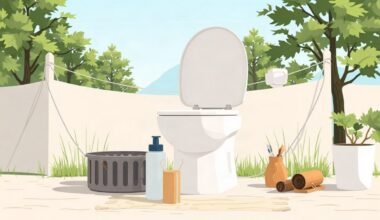
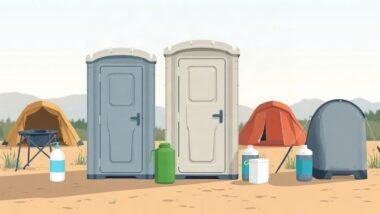
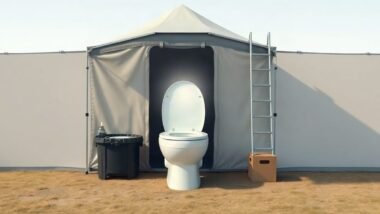
This is where many campers run short. A cassette or portable flushing toilet can consume a meaningful amount of water with each flush, so a family using it several times a day can add a noticeable amount to the daily total. Check your model’s specification for its actual per-flush usage. Practical ways to reduce this:
- Use the minimum flush, or a “dry” approach for liquids where your toilet design allows it.
- Keep a separate small bottle of water labelled for toilet use only, so toilet flushing cannot silently drain your drinking supply.
- Greywater from washing up can sometimes be reused for a first flush, provided it contains no strong detergents or food scraps. Our guide on how to dispose of greywater when camping covers what you can and cannot reuse.
Worked example: family of four, three nights
Two adults and two children, spring camping with daytime temperatures around 20°C, one pot meal per night, basic wash-downs, and a cassette toilet used mainly for solids:
- Drinking: 4 people × 2.5 litres = 10 litres/day
- Cooking and drinks: 4 people × 1 litre = 4 litres/day
- Hygiene: 4 people × 1.5 litres = 6 litres/day
- Toilet flushing: 3 litres/day (rationed flushes)
- Daily total: 23 litres; three nights (four days) = 92 litres
- Emergency buffer: +23 litres, giving a plan of roughly 115 litres, or about 30 US gallons
That is far more than most people bring, which is exactly why the next section matters: you need a plan for refilling, not just for carrying.
What changes the numbers? Hot weather, altitude and activity
Three factors push daily water requirements outdoors upwards. First, heat and sun: sweating losses rise sharply above about 25°C, and drinking needs can double. Second, exertion: a day of hiking or paddling demands more than a day around the campsite. Third, dry air: low humidity increases invisible moisture loss through breath, and also matters for any equipment that depends on moisture in the air, as we will see below.
If the trip involves evening drinks, err on the generous side with your drinking allowance. Illness, particularly vomiting or diarrhoea, can increase needs dramatically, which is one more reason for the spare-day buffer.
Where will you refill? Planning sources, not just quantities
Once you know your total, the second half of the plan is where each litre comes from. The standard sequence for most campers:
- Carried water: enough for at least the first day and emergencies, stored properly. Our guide on how to store and purify water for camping trips safely covers containers, treatment and hygiene.
- Refill points: campsite taps, visitor centres, service stations. Check in advance that the tap is potable; if not, you will need to filter or treat.
- Natural sources: rivers, lakes and streams are a backup only, and always require filtration or treatment before drinking.
- Collected water: rainwater harvesting or, in humid conditions, atmospheric water generation. Both are supplemental, not primary.
Our wider guide to securing an off-grid water supply for dry camping walks through building redundancy into each of these layers.
Can you top up water from the air at a campsite?
There is a growing interest in atmospheric water generation (AWG), the technology behind dehumidifiers and some commercial units used in military and disaster-relief settings. The principle is straightforward: warm humid air passes over a cool surface and moisture condenses into liquid water. Reviews of DIY atmospheric water generators describe output as supplemental at best: even favourable figures cited in these reviews, up to roughly 10 gallons per day, depend on high humidity, and dry conditions produce far less.
Joseph’s Well: a DIY guide, not a machine
Joseph’s Well is a digital DIY guide (video tutorials, printable blueprints, a parts list and bonus materials) that teaches you to build your own condensation-based atmospheric water generator from hardware-store parts. According to the seller, it was created by John Gilmore and is sold through Digistore24 at $39 with a 60-day money-back guarantee. It is not a shipped appliance: cooling components, filtration, storage and any electrical parts need to be sourced separately, depending on the setup.
Three honest caveats before you consider it as a camping top-up option:
- Output claims are unverified and climate dependent. The vendor’s marketing figures conflict between sources, so it would be wrong to quote any yield as fact. Reviews such as Water Ready Home take a cautiously neutral view, noting that whether the design meets the seller’s claims in your conditions is a separate question from whether the concept works.
- It needs power. Condensation requires a cooling element and airflow, so on a campsite you need mains hookup or a substantial power source. That makes it a basecamp option rather than a backpacking one.
- The condensed water must be filtered before drinking. The DIY unit is not a certified potable-water device, as noted in the Joseph’s Well review by Josephs Wall, and any collected water should be filtered and treated before consumption.
Who it suits: hands-on campers and RVers with humid conditions, access to power, and an interest in a supplemental or experimental backup source. Who it does not suit: anyone who needs guaranteed drinking water on day one, anyone camping in dry air (condensation yields drop sharply), and anyone unwilling to assemble and maintain the unit themselves. If that describes you, carry more water or rely on campsite refills instead; rainwater collection is another low-cost top-up in the right season and needs no power at all.
If you are comfortable with those limits and want to see the plans for yourself, you can check out Joseph’s Well on the official site, and confirm the current price and terms at checkout before buying.
How to ration water when your estimate turns out to be low
Even good estimates go wrong. If you notice supply running down faster than planned:
- Prioritise drinking. Never ration drinking water below comfort levels in heat; cut hygiene first, toilet flushing second.
- Switch cooking to minimal-water methods: one-pot meals, or soaking rather than boiling where the meal allows.
- Move toilet use to shared facilities if the campsite has them, keeping the cassette for night-time and emergencies only.
- Send someone to a refill point early in the day rather than waiting until the container is nearly empty.
- Keep a sealed reserve container that nobody touches except in a genuine emergency.
Affiliate recommendation
Mentioned in this article: Joseph’s Well
Joseph’s Well is a DIY guide that, according to the seller, explains how to build a device that collects water from the air. It is instructions, not a ready-made machine.
Read the seller’s information →
Affiliate link: we may earn a commission if you purchase, at no extra cost to you. We have not tested this product.
FAQ
How much water do I need for a weekend camping trip?
For two days and two nights, plan 4 to 6 litres per person per day, so roughly 12 to 18 litres per person, plus a spare day’s worth (4 to 6 litres each) as a buffer. Add 2 to 4 litres per person per day on top if you use a flushing portable toilet heavily or expect hot weather.
How many litres per day in hot weather?
In sustained heat, drinking alone can reach 3 to 4 litres per adult per day, and total needs including cooking and hygiene can approach 8 to 10 litres per person.
How much water does a portable toilet use?
It depends on the model and your flush habits: cassette toilets are generally frugal with water, with many designs using well under a litre per flush. Rationing flushes, using dry methods where appropriate, and keeping toilet water in a separate labelled bottle keeps this from eating your drinking supply.
Is water from a DIY atmospheric water generator safe to drink?
Not without treatment. Condensed water must be filtered before drinking, and a DIY build is not a certified potable-water device. Treat it like any untreated source: filter, purify and, ideally, test the output before relying on it.
Should I bring bottled water or refillable containers?
Refillable jerrycans or collapsible containers are cheaper and produce less waste, provided you refill from known-potable taps and keep them clean. Bottled water is fine as a sealed emergency reserve because it stores reliably and you can see at a glance that it is untouched.
Conclusion
Work out your per-person daily total with the calculator above, add a buffer day, and then plan where each refill will come from before you leave. Water is the one supply that running out of actually ends a trip, so redundancy beats precision. If your campsite has humid air and mains power and you enjoy a build project, the Joseph’s Well guide is one way to explore a supplemental source; otherwise, carried water plus known refill points remains the dependable default. For the wider picture, start with our guide to securing an off-grid water supply for dry camping.
Sources
- Joseph’s Well Review (2026): Honest Look at the DIY Water Guide
- Joseph’s Well Review: DIY Atmospheric Water Guide
- Joseph’s Well Review 2026 What You Get and Key Limitations | Water Ready Home
- Joseph's Well Review: Does This DIY Water System Work?